
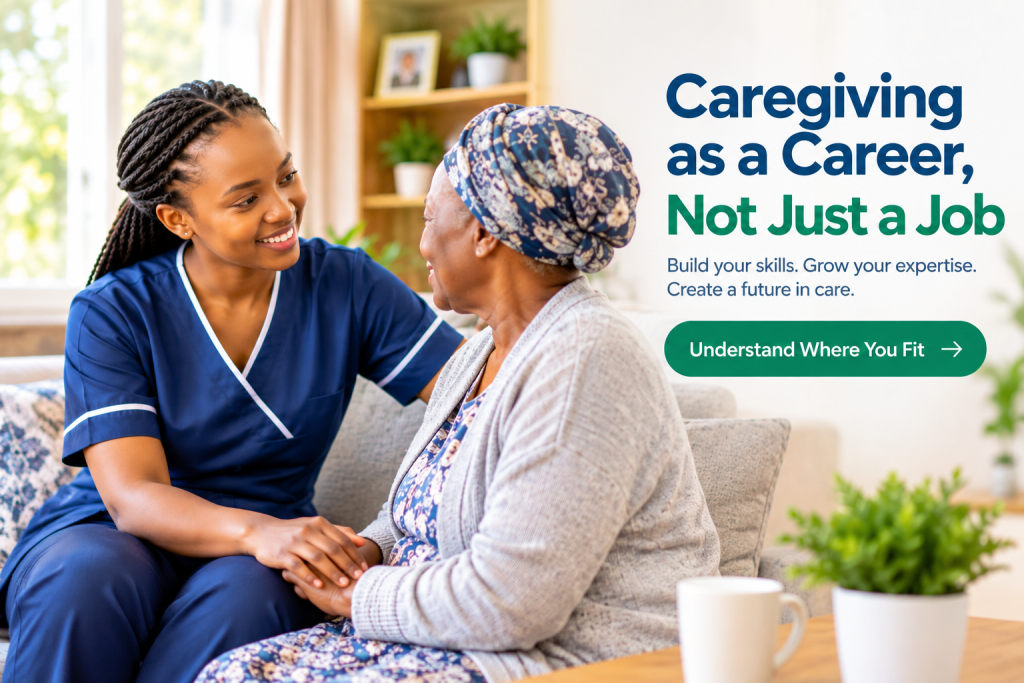
Ask someone what they plan to do “long term,” and caregiving rarely comes up as the answer — even from people who are already doing it. It gets treated as something you fall into, not something you build toward. A stopgap. A kind thing you do for a relative. Work you take on because it needs doing, not because it leads anywhere.
That framing misses something important: caregiving can be a real career, with real progression — but only if there’s a structure to grow within.
| REGISTER NOW TO “October 2026 Caregiver Training Intake” |
The Problem
Without that structure, caregiving work tends to stay flat. Someone starts doing informal caregiving — for a family member, or as paid help for someone else’s — and years later, they’re often doing exactly the same tasks, the same way, with no clear way to show how much they’ve actually learned.
There’s no obvious next step. No way to formalize the judgment they’ve built. No path toward taking on more responsibility, earning more trust, or moving into a more specialized area of care they might genuinely be drawn to, like working with children or with elderly clients specifically.
This isn’t because the work lacks depth. Caregiving is demanding, skilled, and often deeply meaningful. It’s because the career around the work is usually missing — not the work itself.
What Growth in Caregiving Actually Looks Like
It’s worth separating four things that tend to get bundled together under the single word “caregiving.”
The first is doing caregiving work — carrying out tasks, often learned informally, often for a family member or through word-of-mouth arrangements. The second is developing caregiving competence — starting to build real skill and judgment, usually through experience, sometimes through some form of guidance. The third is becoming a professional caregiver — reaching a level where your knowledge, technique, and judgment can be demonstrated and relied upon consistently, not just assumed. The fourth is developing specialized expertise — building deeper capability in a specific area of care, once general professional competence is already solid.
Each of these represents a genuine increase in capability. And each one can be built deliberately, through structured learning and supervised practice — rather than left to accumulate slowly, by chance, over years.
| CAREER INSIGHT
Caregiving work and a caregiving career are not the same thing. The difference isn’t talent or dedication — it’s whether there’s a structure to grow within. |
| REGISTER NOW TO “October 2026 Caregiver Training Intake” |
The Igeno Gate Perspective
This is the thinking behind the Igeno Gate Caregiver Learning Pathway: Foundation Caregiver → Professional Caregiver → Specialization → Continuing Development.
Each level exists so a caregiver’s growth has somewhere concrete to go. Foundation Caregiver builds the fundamentals for someone starting out or formalizing informal experience. Professional Caregiver develops the deeper capability required to handle more demanding situations responsibly. Specialization allows a caregiver who has already established professional-level competence to build focused expertise in a specific area, such as elderly care or infant and child care.
It’s worth being direct about what this pathway is, and isn’t. Completing it does not guarantee a particular job, salary, or placement — Igeno Gate does not make that promise, and no responsible training provider should. What the pathway does offer is something more durable: a structured way to keep developing, so that a caregiver’s actual skill and professional standing can grow over time, rather than staying fixed at whatever level they happened to start.
Practical Takeaway
Think honestly about which of the four stages above describes where you are right now — doing the work, developing competence, working at a professional level, or specializing. Then ask a follow-up question: what would it actually take to move to the next stage deliberately, instead of waiting for it to happen naturally, if it happens at all?
For most people, the honest answer involves structured training — not simply more time doing the same tasks the same way.
Who This Is For
This is especially relevant if you’re a young person exploring caregiving as a career option, someone considering a career change into care work, an informal caregiver who has built real experience but nothing formal to show for it, or someone already doing caregiving work who wants a genuine way to develop further.
| REGISTER NOW TO “October 2026 Caregiver Training Intake” |
Your Next Step
If caregiving is a field you want to grow in — not just work in — the place to start is understanding where you currently sit on that pathway, and what the next stage would involve.
Understand where you fit in the Igeno Gate Caregiver Learning Pathway, and see what building a real caregiving career could look like from here.
| REGISTER NOW TO “October 2026 Caregiver Training Intake”
Or Call/WhatsApp: +250788433298 |