
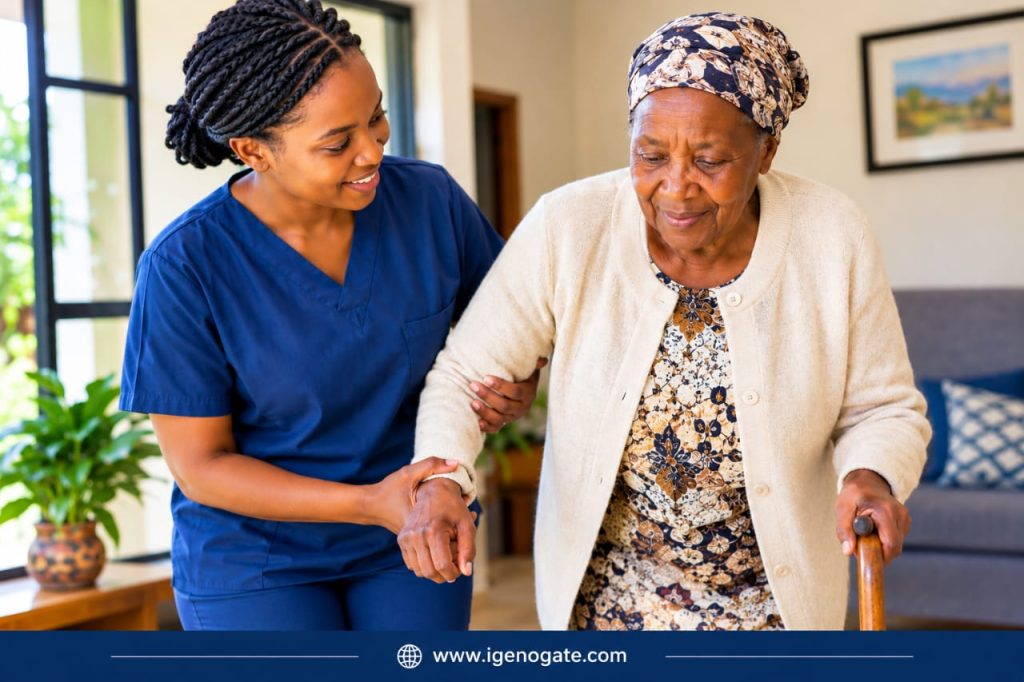
You notice your grandmother is having more trouble getting up from her chair than she used to. Or a neighbour asks if you can sit with her father for a few hours while she runs errands. Or you’ve simply always been “the one who helps” in your family — the person who steps in when someone is sick, ageing, or struggling to manage on their own.
At some point, almost everyone who takes on this role has the same quiet realization: wanting to help and knowing how to help are not the same thing.
“Register for October 2026 Caregiver Training Intake”
The Problem
Caregiving looks simple from the outside. You show up, you assist, you comfort. But anyone who has actually done it — even for a short time — knows it involves constant, small decisions that carry real weight.
How do you help someone stand up without straining your back or hurting theirs? What does it mean when an elderly person suddenly seems more confused than usual — is that normal, or is it something urgent? How do you assist with deeply personal tasks, like bathing or using the toilet, in a way that protects someone’s dignity rather than just getting the task done?
Most people who find themselves caregiving — for a parent, a client, or a person they’ve been asked to look after — were never taught the answers to these questions. They learn by instinct, by trial and error, or by copying what they’ve seen someone else do. Sometimes that’s enough. Often, it isn’t.
This isn’t a criticism of anyone doing this work. It’s simply the truth about caregiving: it is a skill, not a personality trait. Being patient and warm-hearted is a good starting point. It is not, on its own, preparation for the actual physical and judgment-based demands of caring for another person.
What Professional Caregiving Actually Requires
It helps to think about caregiving as a line of development, rather than something you either “have” or “don’t have.”
At one end is good intentions — the instinct to help someone in need. Moving along that line is basic help — doing practical tasks, but without much structure or technique behind them. Further along is structured caregiving — following safe, consistent practices that have actually been learned and practised. And at the far end is professional competence — the ability to notice small changes early, respond calmly under pressure, and carry out care to a standard that has been tested and confirmed, not just assumed.
Most informal caregivers are somewhere between the first two points on that line. That’s not a personal shortcoming. It’s simply what happens when someone takes on caregiving responsibility without ever being offered a structured way to build the skill properly.
Consider a few realistic examples. Someone repositions a bedridden relative daily, using a technique they’ve never had corrected — until one day they hurt their own back doing it. A caregiver notices a client seems unusually tired and irritable but doesn’t recognize it as an early sign of something that needs attention, because no one ever taught them what to watch for. A family member wants to say the right thing to someone who has just received difficult news, but freezes, because comforting someone well is its own skill — one that can be learned, but rarely is by accident.
None of these situations happen because someone didn’t care enough. They happen because caring and competence are two different things, and only one of them can be built through good intentions alone.
| KEY TAKEAWAY
Caregiving is a practical skill, built through repetition, correction, and guided practice — not something a person absorbs simply by being kind or by watching others do it. |
| “Register for October 2026 Caregiver Training Intake” |
The Igeno Gate Perspective
This is exactly the gap that Igeno Gate Academy was built to close.
Igeno Gate’s Caregiver Learning Pathway starts from a simple belief: people who care for others deserve real preparation, not a shortcut. Rather than assuming caregiving skill will simply develop on its own over time, the pathway is built to teach it deliberately — through structured learning, supervised practice, and real assessment.
The pathway itself follows a clear progression: Foundation Caregiver → Professional Caregiver → Specialization → Continuing Development. Each stage builds on the competence developed in the one before it, so a learner is never asked to take on more responsibility than they’ve been prepared for.
Underneath all three levels sits the same learning philosophy: Learn → Practice → Demonstrate → Progress. Learning gives a caregiver the knowledge behind good practice — not just what to do, but why it matters. Practice, under supervision, is where that knowledge starts to become physical skill. Demonstrating competence means proving, not just describing, that the skill has actually been built. And only then does a learner progress to the next stage.
Igeno Gate is not simply teaching people how to care. It is developing people for responsible caregiving — building their judgment, their technique, and their confidence, one stage at a time.
Practical Takeaway
If you are currently caregiving informally — for a family member, a neighbour, or as unpaid work you’ve taken on — it’s worth pausing and asking yourself a direct question: which specific moments have made you feel unsure of what to do?
That uncertainty isn’t a weakness. It’s useful information. It tells you exactly where structured training could make the most difference — whether that’s safe physical assistance, recognizing early warning signs, or simply communicating more confidently during difficult moments.
Who This Is For
This matters most if you are already caring for someone informally and want to do it with more confidence, if you’ve considered caregiving as a possible career but aren’t sure where the learning would even begin, or if you’ve simply felt that gap between wanting to help and knowing how to help well.
Your Next Step
You don’t need previous experience or formal qualifications to start closing that gap. The Igeno Gate Caregiver Learning Pathway begins with Foundation Caregiver — an entry point specifically designed for people who are new to structured caregiving, whatever their background.
REGISTER Now to OCTOBER 2026 Caregiver Training Intake: https://www.igenogate.com/october-2026-registration-form/
OR LEARN MORE: https://www.igenogate.com/become-a-professional-caregiver/
GET ASSISTANCE:
- Email: info@igenogate.com
- Call/ WhatsApp: +250788433298